











Five Myths About Modern Education

Over the years I’ve kept a short list of assertions that often occupy the minds of students and parents alike. The power of these assertions tends to wax and wane from one decade to the next, but in general, each has staying power in our social imagination.

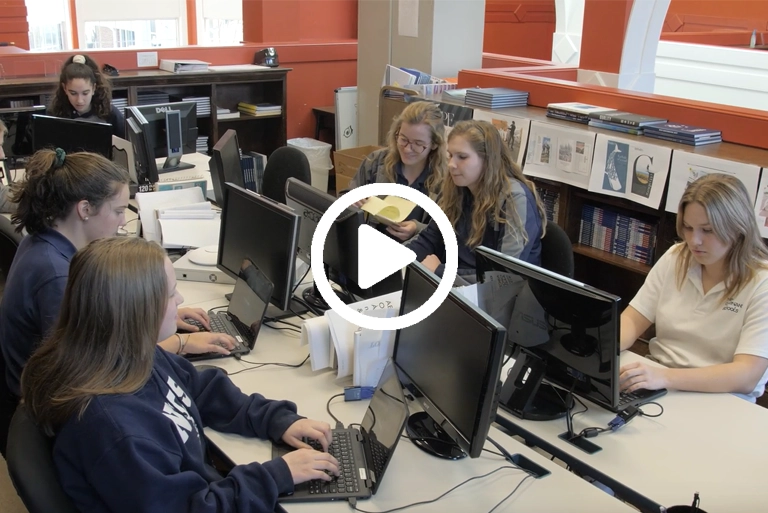
The inclusion of technology is essential. By 2014 the majority of Americans had a smartphone. That was not the beginning, but rather the climax of the push to chase technology in the classroom. This was the same year that Google Classroom hit the market, a development that sought not only to make educators’ lives more efficient, but also to control how curriculum is shaped and delivered. I routinely fielded questions from prospective parents who thought our “tech-lite” policy was ill-conceived. Ten years later, I no longer get the question. Parents intuitively know that chasing technology for its own sake is unwise; most do not want their children in front of screens for any significant amount of time; and current neuroscience research is backing this position strongly. New Covenant has been phone-free for more than a decade and judiciously commits to technology when there is a clear mandate to do so.

Classical, Christian education is only for the elite, and ignores the non-liberal or common arts. This assertion was more prominent twenty years ago. It stems from the fact that classical education was the default curriculum tradition for nearly all of America’s elite preparatory schools and Catholic schools in the 18th – 20th centuries. Returning to this tradition, after wandering for a century in the wilderness of progressive educational models of John Dewey, seemed a bit stuffy and perhaps mildly elitist. It doesn’t have to be this way. Mortimer Adler of the University of Chicago quipped that “the education that is good for the wealthy is good for everyone.” He was a strong proponent of the idea that public education should return to this tradition. In the Christian expression of classical education, greater attention is given to embracing the whole person. At New Covenant, we strive to aid those who might need help gaining such an education through a robust tuition assistance program. Additionally, recent programming adjustments at the high school level (J-term offerings) allow for the exploration of the common arts.

Students will have more friends and more opportunities in a larger school. This assertion is more complicated because it entails more variables. It may be true that students who fail to make friends in a smaller context have “no place to go to find them.” After nearly 30 years at New Covenant, however, I would affirm that this is generally not traceable to school size, but to a variety of factors in play within interpersonal relationships. Viewed another way, a school the size of New Covenant actually expands opportunities. Average athletes who would be recruited over in a bigger school actually get playing time. School-wide activities are possible because of manageable numbers. What academy can take its entire high school by charter bus to Washington, DC for an overnight excursion of the city every year? New Covenant can do such things and a dozen others that are not options in larger contexts. While the larger school may in fact have many choices, students realistically cannot take advantage of all of them all.

Advanced Placement (AP) is the gold standard for education. The College Board is a private organization that has long behaved like a cartel in the field of education. It controls the PSAT/SAT exams, drives college admissions processes, publishes AP curriculum for high schools, and engages in political advocacy. Moreover, AP courses tend to inform and drive curriculum courses and pedagogy. For example, the current pace of AP Latin requires 18 lines of translation per night, likely more than an hour of homework in one discipline. This alone drives out significant reflection upon the text because the pacing is breathless. AP Biology is prohibitively dense, and countless more examples abound. We therefore severely limit AP offerings.

Furthermore, when looking at the data from ISM and other sources, college admissions offices are so inundated with competitive student transcripts that AP is only one small snapshot on a student record. Colleges are routinely looking for students who stand out: enter the classical, Christian student and a college guidance program that knows New Covenant Schools. In the college admissions world, applicants who take the highest level courses that their school offers are the golden key, not AP or even dual enrollment (more below). Additionally, college admissions representatives are continually impressed with our program and our students through regular campus visits to our school.

Dual Enrollment is the wave of the future. There is no question that colleges are facing the great student “drop-off” in the next decade and are responding according to their bottom line. Fewer students are choosing to go, and the total number of available students is slowing due to population decline. Many university models are recruiting younger ages by offering college credit while a student is in high school, establishing themselves as another institution that dictates curriculum and testing at the secondary level. Moreover, colleges monitor and evaluate high school teachers, curriculum, and pedagogy. However, liberal arts education is to form the individual as a whole person in age-appropriate ways. Reaching down to high school and accelerating students through college-level material circumvents true learning. Students desperately need age-appropriate instruction, predictability, and support structures to learn optimally. New Covenant features personal teacher attention and availability, working with students through each stage and year. This process cannot be fast tracked.

A new analysis released in October 2024 by the Community College Research Center (CCRC), tracked what happened to every high school student who started taking dual enrollment classes in 2015. Almost 30 percent of the dual enrollees earned a bachelor’s degree in four years, but 58 percent had not earned any college degree or any post-secondary credential within this four-year period. Arguably, dual enrollment credits are not making a huge difference in time to completion, on average. The credits do not always transfer favorably, or, more importantly, count toward a student’s requirements in a major, which is what really matters and holds students back from graduating on time.

New Covenant Schools
Unique among the offerings in the greater Lynchburg area, New Covenant remains the premier classical, Christian program of the region, firmly established and vetted over three decades. According to ISM (2023), schools like New Covenant are a prime feature in the market who “design a truly independent, mission-and core values-based curriculum.”


Five Myths About Modern Education

Over the years I’ve kept a short list of assertions that often occupy the minds of students and parents alike. The power of these assertions tends to wax and wane from one decade to the next, but in general, each has staying power in our social imagination. The inclusion of

Read More »

Education: The Architecture of a Whole Person

This blog was contributed by Dr. Erin Uminn, Principal of the School of Rhetoric. | The first time I toured the Library of Congress in Washington D.C. it took my breath away. Guests make their way through security, turn down attractive corridors, and finally spill into the large, open lower

Read More »

Parenting—User’s Manual Not Included

This blog was contributed by Bridges Spiva, Grammar School Principal. On the way home from the hospital with our first son, I vividly remember my husband’s and my admiring our tiny passenger in the backseat and remarking, “We can’t believe they just let us take him home!” In that moment,

Read More »

Linda Simon is the director of Alumni Affairs.  She has been a part of the New Covenant Schools community since 2007, and brings years of experience and deep personal connection to her role as in this position. As the former Director of Admissions and proud mom of two NCS alumni, she is passionate about fostering lasting relationships between the school and its graduates. Her work focuses on keeping alumni engaged, connected, and involved in the life of the school they once called home.

Kathryn Martin serves as the principal of the School of Dialectic (grades 5-8).  She first joined New Covenant as a volunteer in 1996. After earning her bachelor’s degree in education, she was hired as a fourth-grade teacher in 1998, serving as a lead teacher for eight years. She then transitioned to the middle school, where she taught English and history and spent 15 years as assistant principal. In 2022, while completing her first year in Gordon College’s Master’s in Leadership for Classical Christian Schools program, she became middle school principal. Kathryn continues to teach history and treasures the opportunity to guide students through the formative “age of becoming.”  Kathryn states “New Covenant has enriched my life in unquantifiable ways over the past 28 years, and I am, in many ways, who I am today because of my time here.”

Linda Hackenbracht has served as Director of Finance at New Covenant Schools since 2018. A Virginia Tech accounting graduate and CPA, she began her career with Ernst & Young auditing nonprofit clients before becoming Controller for the Catholic Diocese of Richmond. After moving to Lynchburg, she offered financial counseling to churches and nonprofits while raising four children, all of whom attended New Covenant. Drawing on her nonprofit expertise, Linda has strengthened the school’s financial foundation and is honored to support its mission, inspired by the transformative impact of classical Christian education on her own family.

Dayna Renalds has served as the Director of Development since 2013. She earned her Bachelor of Science in Broadcasting and Journalism from Liberty University and her Master’s in Speech-Language Pathology from the University of Tennessee.  Before her current role, she worked with the area schools as a speech therapist, bringing her expertise in communication and education to the community.  During her tenure at New Covenant Schools, Dayna has led three successful capital campaigns to expand the campus and played a key role in establishing the school’s scholarship foundation, enabling donors to receive significant tax benefits for their contributions.  Dayna enjoys spending her free time with her five children, three of whom are proud alumni of New Covenant Schools, making memories together.

John Maynard has been serving in the role of Athletic Director at New Covenant since 2020 and is in his sixth year of service. John has been an Athletic Director in North Carolina, South Carolina and now Virginia; a career in the Education/Athletic field spanning 15 years. He has served on Executive Board for the Blue Ridge Athletic Conference and will continue to do so this school year. John graduated from the University of North Carolina – Chapel Hill in 2009 with a degree in Exercise Sport Science – Sport Administration. He is married to Kelsey Maynard, a fellow educator, and together they have one daughter.

Tiffany Fulcher is the Director of Parent Relations.  A proud mom of two New Covenant students, Tiffany has been part of the school community for years—first behind the scenes in the office and now helping parents navigate everything from lunch options to uniforms. Tiffany is the go-to person for questions regarding lunches, uniforms, or volunteer opportunities. She enjoys working with the parent community and welcomes questions and feedback.  Her goal is to make the New Covenant experience smooth for everyone in our community.  She also enjoys shopping for bargains in her free time.

Darren Johnson has served as the Facilities Manager at New Covenant since the summer of 2020.  He earned a Bachelor of Science in Sport Management from Liberty University in 1992, where he was a three-year scholarship athlete on the university’s tennis team.  Darren was employed for 25 years as the Director of Corporate Sales and Head Groundskeeper for the minor league baseball team, The Lynchburg Hillcats. In this capacity he kept the playing field in pristine condition.  He also has experience with operations and customer service in the lawn and garden industry.  Outside of work, Darren enjoys hunting, fishing, and golf. He has been married to his wife, Susanne, for 31 years, and they have two children.

Dr. Erin Uminn is the Principal of the School of Rhetoric (9th-12th). She has served since 2013 when she joined the dialectic faculty to teach literature, writing, history, and Bible, a post she held for 10 years. From 2021-2024 she worked to establish a predictable and supportive structure within a classical, Christian educational framework for students in the School of Dialectic (5th – 8th) as the Student Support Coordinator. This established support later grew into the fully staffed, Marion A. Patterson Center for Paideia. She received her Ph.D. in Education from Liberty University in 2023. Her dissertation included a qualitative research study on classical, Christian educators and how their intentional leisure practices directly informed their teaching and impacted students in the classroom. Dr. Uminn holds the B.S. in Multidisciplinary Studies: English, Psychology, and Education and the M.A. in Human Services: Marriage and Family Therapy. She currently teaches Senior Thesis as an advisor and chair for the senior thesis capstone project.

Eliza Olson is the Director of Admissions and holds a Bachelor of Science in Counseling. She and her husband, Nick, have two children at New Covenant. Before joining the staff, Eliza served as the director of a local Classical Conversations community. Having volunteered many hours and being a parent herself, she greatly enjoys connecting with New Covenant’s prospective families. From the moment you schedule a tour, to submitting an application, to beginning your journey as the parent of a new student, Eliza will be there to guide and support you.

Andrea Adams is the Office Manager.  Andrea was first introduced to classical Christian education in 2010 while seeking an alternative to public schooling for her children. They attended New Covenant Schools for their middle and high school years, where they were deeply impacted by the school’s Christ-centered, rigorous approach to learning.  Over the years, she volunteered in various capacities at the school, gaining firsthand experience in school operations and community life. In 2020, she joined the staff where she continues to serve by overseeing the day-to-day functions of the office, supporting faculty and staff, and ensuring smooth communication with parents and students. Her role allows her to combine administrative excellence with a passion for fostering a nurturing, faith-based educational environment.  Andrea holds a Bachelor of Arts in Economics.

Bridges Spiva is New Covenant’s second grammar school principal, following the founding principal, Marion Patterson. She has served since 2010 and is in her sixteenth year of service. Mrs. Spiva began her tenure teaching 3rd grade in the grammar school and taught math, science, and Bible in the middle school. Prior to a career in teaching, Mrs. Spiva worked as a probation officer and supervisor with the Department of Juvenile Justice. She holds a BS in Communications, Master of Public Administration, and Master of Leadership in Classical Education. Both of her sons, Wagner (2020) and Waylon (2022) are graduates of New Covenant. Mrs. Spiva and her husband Jay enjoy cheering on the Hokies and spoiling their bulldog, Hazel.

The Rev’d John Heaton is New Covenant’s second headmaster, following the founder of the school, Dr. Robert Littlejohn.  He has served since 1998 and is in his twenty sixth year of service.  He established the school on its permanent campus at Fleetwood Drive in Lynchburg, VA, and led the development of the school through five successful capital campaigns, providing the facilities which now serve more than 450 students through grade 12.  Fr. John is an ordained minister in the Reformed Episcopal Church and has served a parish in his home state of Florida.  He currently serves as the Associate Priest at All Saints Church which meets in the Marie Macdonald Chapel on the campus of New Covenant. Fr. John holds the BA and MA in theology, and the MA in liberal studies.   He teaches intermediate Greek in the School of Rhetoric, and he writes routinely for this blog below.

Privacy Overview

This website uses cookies so that we can provide you with the best user experience possible. Cookie information is stored in your browser and performs functions such as recognising you when you return to our website and helping our team to understand which sections of the website you find most interesting and useful.