

Classical Education, Mozart and the Class of 2022

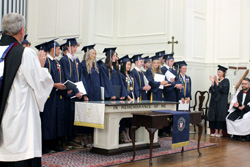
In this edition of QUID NOVI we highlight the class of 2022. While you might be meeting them for the first time, we are preparing to say our goodbyes at a soon-coming graduation! Many of the members of this class started right here in kindergarten; others joined them along the way. Just yesterday—it seems —I was opening their car doors, greeting them as they scurried off into their kindergarten classes, and chuckling at their oversized backpacks. Their cuteness was mightily endearing, but as they’ve grown into young adulthood, that fondness has turned into deep and abiding affection. What they’ve become fills me with hope for the future. Together, they have spent years acquiring the necessary tools of learning to succeed wherever their paths take them.

Classical educators like us often find ourselves in the position of having to defend our approach. We are in a skills economy, we are told, and students must be prepared for global competition. Education must focus on skills . . . which is another way of saying nothing! Nobody knows what kind of world this class will inherit, and there is no way to impart the particular skills needed for what we don’t know. Anybody who got a computer science degree in 1987 has had to upgrade training more often than Microsoft releasing its next version of Windows!

Consciously or unconsciously, many have bought into the fallacy that raw talent can take the place of training, which is, of course, the foundation of a skill. Skill is nothing more than a trained practice, and, as the adage goes, “Practice makes perfect.” But the new rock-solid conviction is advanced anyway, along with its companion idea that children’s esteem must be built by continually telling them that they are great, as if nothing they produced needed much correction.

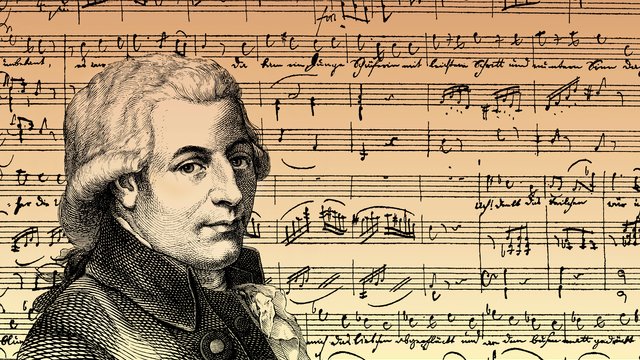
Both of these fallacies are supported with the familiar citations of musicians or artists, such as Mozart, whose talent, we would be led to believe, could be recognized as nearly mature at birth. Not only is this untrue, but even if it were, it would hardly be a fair standard against which average children should be measured. Mozart had an unbelievable ability to remember large swatches of notes, but at an early age he figured out how to put this innate ability to good use. It took him hours of practice to do it. He could sit down at a keyboard and perform for the average hearer an improvisation that seemed spontaneous. In reality he was merely linking up musical progressions he had spent hours committing to memory, much as the medieval minstrel could link up previously worked out literary couplets and epithets on the fly, tailoring them to a local audience to the amusement of all.

There are never any shortcuts, although some minds can take the curves faster. This explains the astonishing fact that when Mozart put his composition on paper, he made few corrections. His charts give the impression of simple genius minus work. What we have come to discover from Mozart’s letters, however, is that his work was done inside his very smart head, where he went over and over his scores repeatedly before he picked up a pencil.

Repeating an action again and again enables self-criticism. Educational experts in our day avoid repetitive learning as mind-numbing. Afraid of boring children, avid to present ever-different stimulation, the enlightened teacher is told to avoid routine. But in doing so they deprive children of the experience of studying their own ingrained practice and modulating it from within.

As the class of 2022 completes its work in just a few days, they will conclude a long regimen of study which included plenty of repetition and memory work, but it also imposed a year-over-year routine of study habits and practices upon which these students will be able to build. As their skill develops, the contents of what is repeated can change. Our seniors, for example, just completed their senior thesis presentations (see their titles on the Honoraria pages). None of them could have imagined this project as a Grammar School student, and many of them dreaded it as they concluded middle school and entered the School of Rhetoric. By the time Thesis Day arrived, however, they had been carefully “scaffolded” through a pedagogy that magnified their abilities, in some cases to their own surprise and delight. The project was concluded with palpable confidence, and their skill in presenting their topics was obvious.

Returning to Mozart, we know that at around age six or so, he was fascinated by the Neapolitan-sixth chord progression, moving, say, from C major to an A-flat major. After a few years of working with it, he became adept in inverting the shift to other positions. That is key. Mozart acquired skill with certain musical realities. Then he innovatively and successfully applied the skill in different ways. Few of our students begin with Mozart’s innate genius. All of them, however, can benefit from his methods, which entailed repetition and sustained attention to the mastery of information and technique. Once mastered, this could be put to higher use.

The class of 2022, like all students who sojourn through New Covenant, experience a pedagogy designed to provide the mind with facility to find and solve problems. When we talk about preparing students for a skills-based economy, there is nothing that will prepare them better than a classical, Christian education. Now that they have finished their course, we eagerly await to see their efforts come to fruition as they step out into young adulthood. Congratulations to the class of 2022.

Five Myths About Modern Education

Over the years I’ve kept a short list of assertions that often occupy the minds of students and parents alike. The power of these assertions tends to wax and wane from one decade to the next, but in general, each has staying power in our social imagination. The inclusion of

Read More »

Education: The Architecture of a Whole Person

This blog was contributed by Dr. Erin Uminn, Principal of the School of Rhetoric. | The first time I toured the Library of Congress in Washington D.C. it took my breath away. Guests make their way through security, turn down attractive corridors, and finally spill into the large, open lower

Read More »

Parenting—User’s Manual Not Included

This blog was contributed by Bridges Spiva, Grammar School Principal. On the way home from the hospital with our first son, I vividly remember my husband’s and my admiring our tiny passenger in the backseat and remarking, “We can’t believe they just let us take him home!” In that moment,

Read More »

Linda Simon is the director of Alumni Affairs.  She has been a part of the New Covenant Schools community since 2007, and brings years of experience and deep personal connection to her role as in this position. As the former Director of Admissions and proud mom of two NCS alumni, she is passionate about fostering lasting relationships between the school and its graduates. Her work focuses on keeping alumni engaged, connected, and involved in the life of the school they once called home.

Kathryn Martin serves as the principal of the School of Dialectic (grades 5-8).  She first joined New Covenant as a volunteer in 1996. After earning her bachelor’s degree in education, she was hired as a fourth-grade teacher in 1998, serving as a lead teacher for eight years. She then transitioned to the middle school, where she taught English and history and spent 15 years as assistant principal. In 2022, while completing her first year in Gordon College’s Master’s in Leadership for Classical Christian Schools program, she became middle school principal. Kathryn continues to teach history and treasures the opportunity to guide students through the formative “age of becoming.”  Kathryn states “New Covenant has enriched my life in unquantifiable ways over the past 28 years, and I am, in many ways, who I am today because of my time here.”

Linda Hackenbracht has served as Director of Finance at New Covenant Schools since 2018. A Virginia Tech accounting graduate and CPA, she began her career with Ernst & Young auditing nonprofit clients before becoming Controller for the Catholic Diocese of Richmond. After moving to Lynchburg, she offered financial counseling to churches and nonprofits while raising four children, all of whom attended New Covenant. Drawing on her nonprofit expertise, Linda has strengthened the school’s financial foundation and is honored to support its mission, inspired by the transformative impact of classical Christian education on her own family.

Dayna Renalds has served as the Director of Development since 2013. She earned her Bachelor of Science in Broadcasting and Journalism from Liberty University and her Master’s in Speech-Language Pathology from the University of Tennessee.  Before her current role, she worked with the area schools as a speech therapist, bringing her expertise in communication and education to the community.  During her tenure at New Covenant Schools, Dayna has led three successful capital campaigns to expand the campus and played a key role in establishing the school’s scholarship foundation, enabling donors to receive significant tax benefits for their contributions.  Dayna enjoys spending her free time with her five children, three of whom are proud alumni of New Covenant Schools, making memories together.

John Maynard has been serving in the role of Athletic Director at New Covenant since 2020 and is in his sixth year of service. John has been an Athletic Director in North Carolina, South Carolina and now Virginia; a career in the Education/Athletic field spanning 15 years. He has served on Executive Board for the Blue Ridge Athletic Conference and will continue to do so this school year. John graduated from the University of North Carolina – Chapel Hill in 2009 with a degree in Exercise Sport Science – Sport Administration. He is married to Kelsey Maynard, a fellow educator, and together they have one daughter.

Tiffany Fulcher is the Director of Parent Relations.  A proud mom of two New Covenant students, Tiffany has been part of the school community for years—first behind the scenes in the office and now helping parents navigate everything from lunch options to uniforms. Tiffany is the go-to person for questions regarding lunches, uniforms, or volunteer opportunities. She enjoys working with the parent community and welcomes questions and feedback.  Her goal is to make the New Covenant experience smooth for everyone in our community.  She also enjoys shopping for bargains in her free time.

Darren Johnson has served as the Facilities Manager at New Covenant since the summer of 2020.  He earned a Bachelor of Science in Sport Management from Liberty University in 1992, where he was a three-year scholarship athlete on the university’s tennis team.  Darren was employed for 25 years as the Director of Corporate Sales and Head Groundskeeper for the minor league baseball team, The Lynchburg Hillcats. In this capacity he kept the playing field in pristine condition.  He also has experience with operations and customer service in the lawn and garden industry.  Outside of work, Darren enjoys hunting, fishing, and golf. He has been married to his wife, Susanne, for 31 years, and they have two children.

Dr. Erin Uminn is the Principal of the School of Rhetoric (9th-12th). She has served since 2013 when she joined the dialectic faculty to teach literature, writing, history, and Bible, a post she held for 10 years. From 2021-2024 she worked to establish a predictable and supportive structure within a classical, Christian educational framework for students in the School of Dialectic (5th – 8th) as the Student Support Coordinator. This established support later grew into the fully staffed, Marion A. Patterson Center for Paideia. She received her Ph.D. in Education from Liberty University in 2023. Her dissertation included a qualitative research study on classical, Christian educators and how their intentional leisure practices directly informed their teaching and impacted students in the classroom. Dr. Uminn holds the B.S. in Multidisciplinary Studies: English, Psychology, and Education and the M.A. in Human Services: Marriage and Family Therapy. She currently teaches Senior Thesis as an advisor and chair for the senior thesis capstone project.

Eliza Olson is the Director of Admissions and holds a Bachelor of Science in Counseling. She and her husband, Nick, have two children at New Covenant. Before joining the staff, Eliza served as the director of a local Classical Conversations community. Having volunteered many hours and being a parent herself, she greatly enjoys connecting with New Covenant’s prospective families. From the moment you schedule a tour, to submitting an application, to beginning your journey as the parent of a new student, Eliza will be there to guide and support you.

Andrea Adams is the Office Manager.  Andrea was first introduced to classical Christian education in 2010 while seeking an alternative to public schooling for her children. They attended New Covenant Schools for their middle and high school years, where they were deeply impacted by the school’s Christ-centered, rigorous approach to learning.  Over the years, she volunteered in various capacities at the school, gaining firsthand experience in school operations and community life. In 2020, she joined the staff where she continues to serve by overseeing the day-to-day functions of the office, supporting faculty and staff, and ensuring smooth communication with parents and students. Her role allows her to combine administrative excellence with a passion for fostering a nurturing, faith-based educational environment.  Andrea holds a Bachelor of Arts in Economics.

Bridges Spiva is New Covenant’s second grammar school principal, following the founding principal, Marion Patterson. She has served since 2010 and is in her sixteenth year of service. Mrs. Spiva began her tenure teaching 3rd grade in the grammar school and taught math, science, and Bible in the middle school. Prior to a career in teaching, Mrs. Spiva worked as a probation officer and supervisor with the Department of Juvenile Justice. She holds a BS in Communications, Master of Public Administration, and Master of Leadership in Classical Education. Both of her sons, Wagner (2020) and Waylon (2022) are graduates of New Covenant. Mrs. Spiva and her husband Jay enjoy cheering on the Hokies and spoiling their bulldog, Hazel.

The Rev’d John Heaton is New Covenant’s second headmaster, following the founder of the school, Dr. Robert Littlejohn.  He has served since 1998 and is in his twenty sixth year of service.  He established the school on its permanent campus at Fleetwood Drive in Lynchburg, VA, and led the development of the school through five successful capital campaigns, providing the facilities which now serve more than 450 students through grade 12.  Fr. John is an ordained minister in the Reformed Episcopal Church and has served a parish in his home state of Florida.  He currently serves as the Associate Priest at All Saints Church which meets in the Marie Macdonald Chapel on the campus of New Covenant. Fr. John holds the BA and MA in theology, and the MA in liberal studies.   He teaches intermediate Greek in the School of Rhetoric, and he writes routinely for this blog below.

Privacy Overview

This website uses cookies so that we can provide you with the best user experience possible. Cookie information is stored in your browser and performs functions such as recognising you when you return to our website and helping our team to understand which sections of the website you find most interesting and useful.